
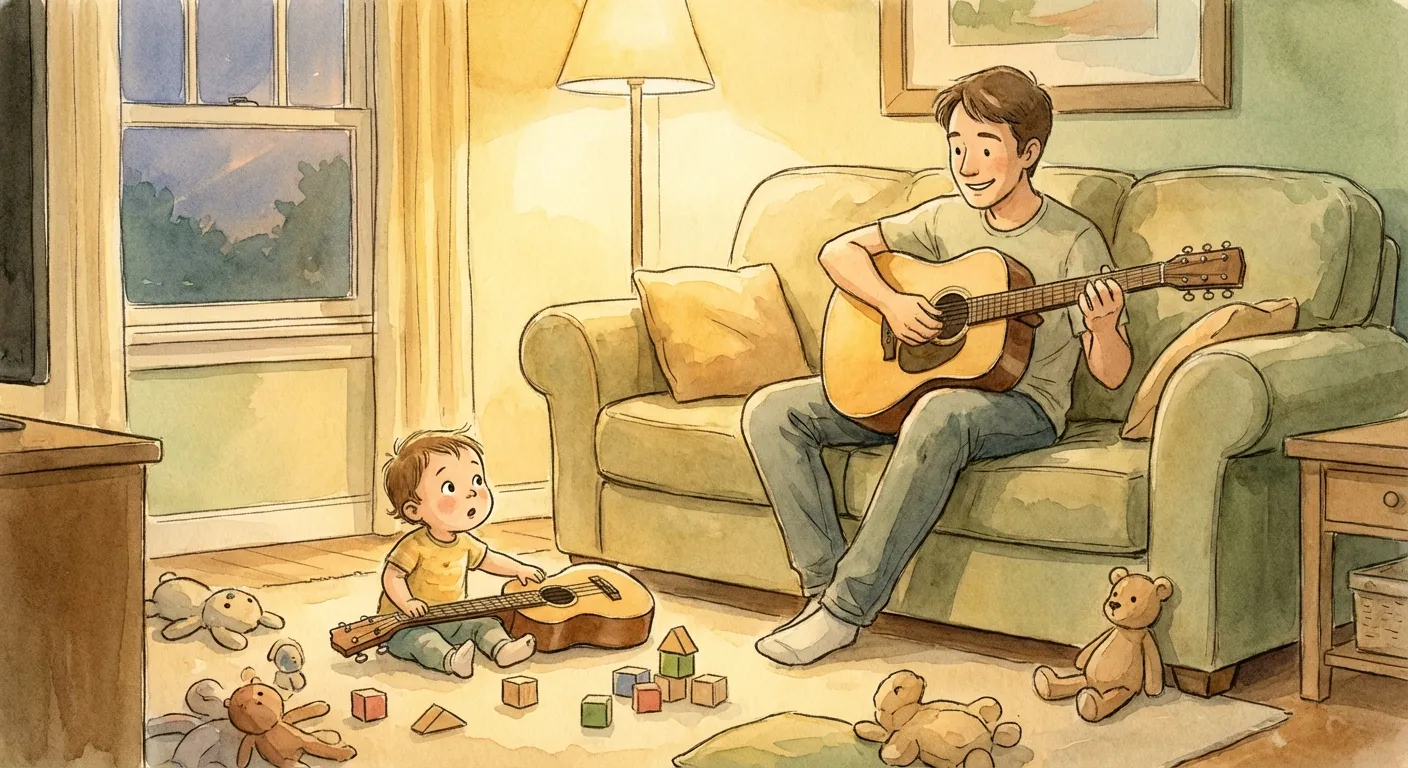
Your Kid Doesn't Need Lessons. They Need to Catch You Having Fun.
You don't need to be skilled at the activity. You need to be genuinely engaged.
- Kids detect fake enthusiasm instantly. But when they see you absorbed in something real — guitar, cooking, shooting hoops — the activity becomes tied to family connection instead of obligation.
- The move: find something you actually love, do it visibly, and when they wander over, just let them in.
The talent development pattern researchers found in 75% of world-class performers starts in the living room, not the classroom.
Here's a weird thing about the best tennis players, pianists, and scientists in the world: almost none of them started with a formal lesson.
They started by watching someone in their family do the thing. Dad plays tennis on weekends because he loves tennis. Mom plays piano after dinner because she loves piano. Nobody is performing for the kid. Nobody is thinking about talent development. The kid is just... there. Absorbing.
And that turns out to be the single most powerful advantage a child can have.
Developmental psychologists studying world-class achievers across sports, music, and the arts found the same pattern over and over: the highest performers didn't begin with instruction. They began by belonging. The activity was already happening in the house. By the time anyone signed them up for anything, they already felt at home in that world.
The 4-Step Absorption Sequence
Researchers identified a consistent sequence in how these kids moved from "tagging along" to "prodigy-level head start." It's not a program. It's not a curriculum. It's four things that happen naturally when a parent genuinely enjoys something.
Modeling
The child sees you enjoying the activity for your own pleasure. Not for their benefit. Not as a demonstration. You play because you love playing. The child registers: this thing brings joy.
Tagging Along
The child joins in casually. Nobody corrects their grip or counts their reps. They're just there, participating alongside the family. Hitting balls, plunking keys, kicking around in the yard.
Quiet Skill Building
Without anyone calling it "practice," the child gets better. Comfort builds. Familiarity grows. By the time anyone notices, they've developed a base that kids starting cold simply don't have.
Seamless Liftoff
When formal lessons begin (around age 6-7), they feel like a natural extension of what the child already does. No friction. No cold start. The teacher sees a "natural" -- but it's really hundreds of hours of casual exposure at work.
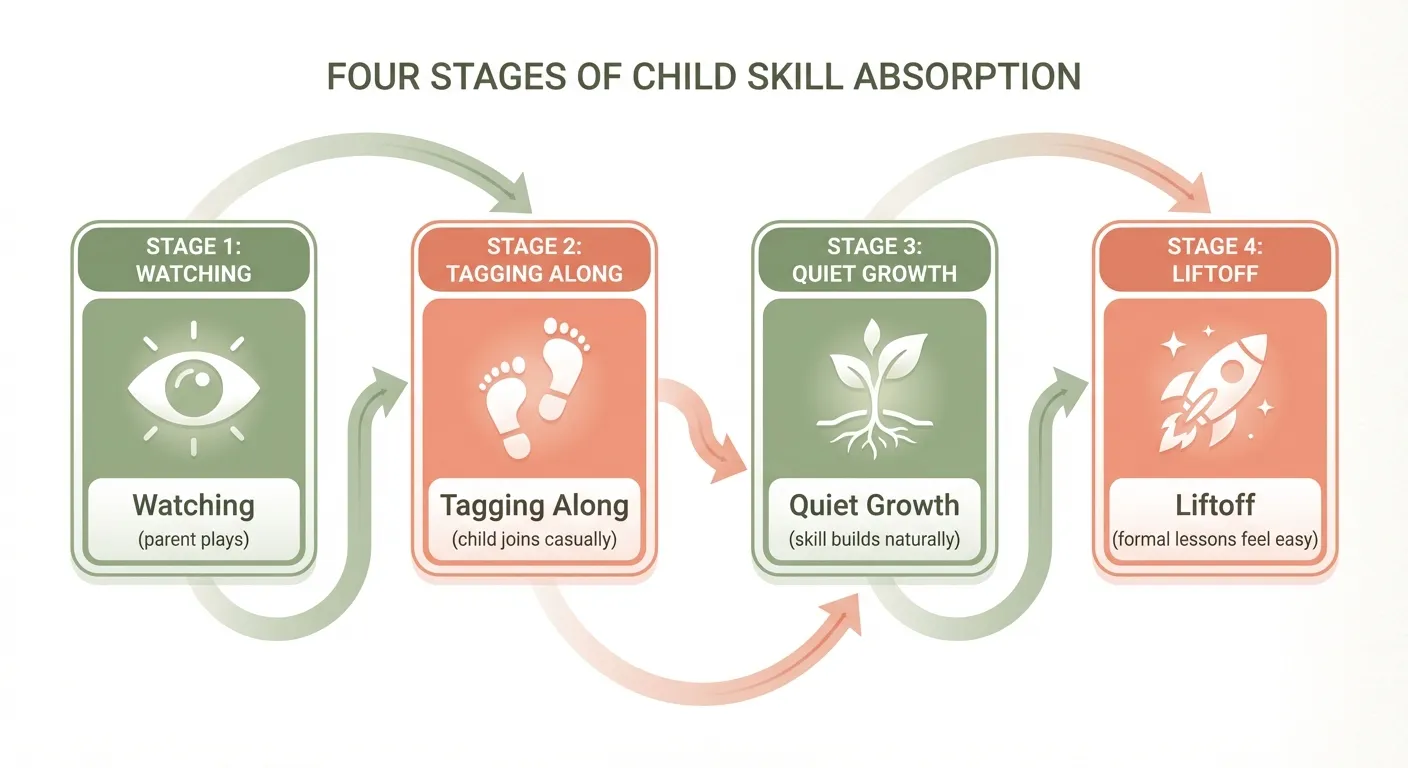
The absorption sequence happens so naturally that most families don't realize it's happening
Cold Start vs. Living Room Start
The difference between a child who's been absorbing an activity at home and one who walks into a first lesson with zero exposure is enormous. Same age, same lesson, completely different starting points.
Cold Start
- Activity feels foreign and unfamiliar
- Child needs to learn the feel of it before learning the skill
- Motivation comes from external pressure ("We signed you up")
- Quitting is easy because there's no emotional connection yet
Living Room Start
- Activity already feels like home
- Child has hundreds of hours of casual familiarity
- Motivation is internal ("This is what we do")
- Lessons feel like the obvious next step, not an imposition
The hidden mechanism
The tight family bond is what makes this work. Across the families studied, one pattern kept surfacing: parents spent a lot of time with their children. The activity was something the family shared, not something the child was sent away to do. That's why it becomes identity, not obligation.
Three Gear Shifts
The journey from "tagging along on Saturday" to "this is who I am" doesn't happen in one moment. It moves through three distinct gear shifts. Each one raises the stakes. Each one feels natural because of what came before.
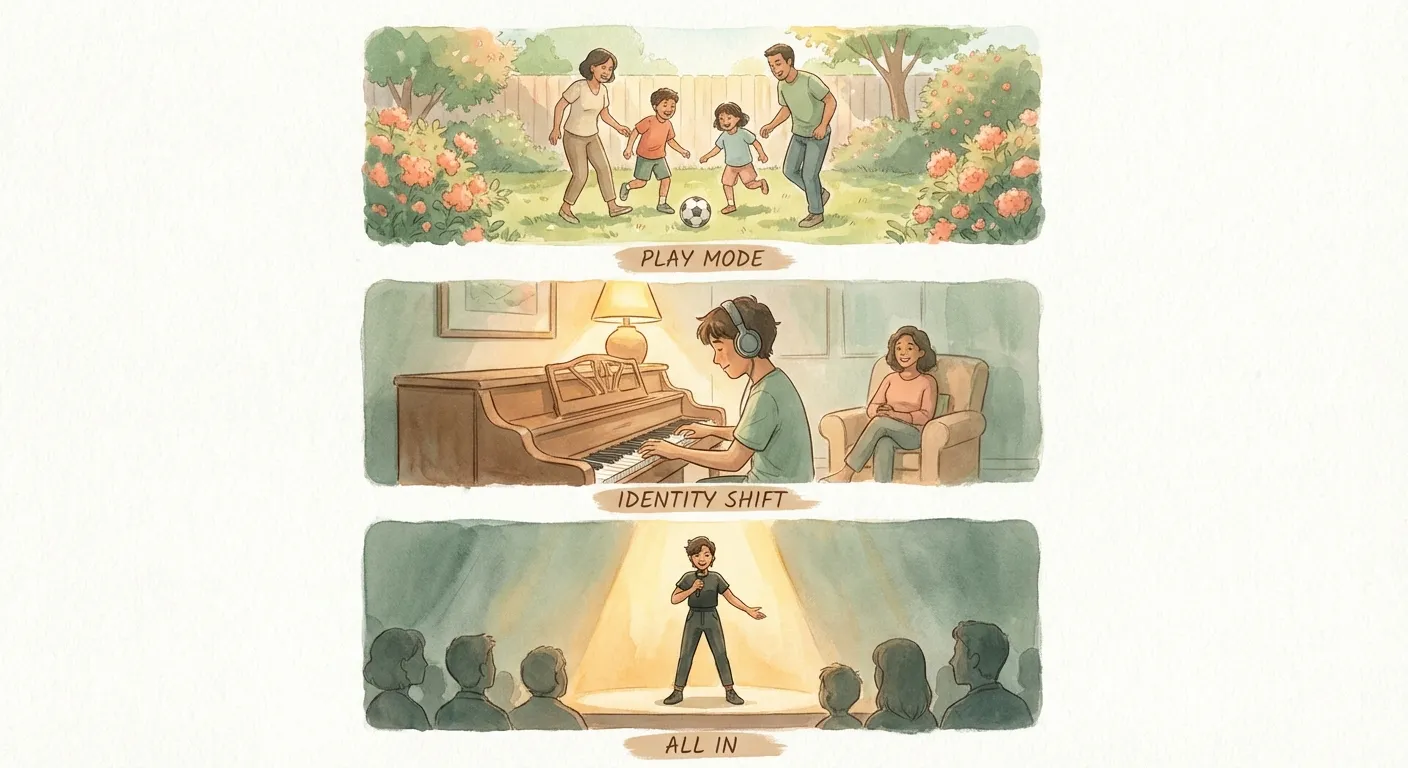
| Gear | What It Looks Like | Age Range | Parent's Role |
|---|---|---|---|
| 1. Play Mode | Pure recreation. The child participates because the family participates. Emphasis on fun and togetherness, zero pressure. | Early years | Just enjoy it yourself. Let them tag along. |
| 2. Identity Shift | The child starts calling themselves "a swimmer" or "a musician" rather than "a kid who does that." Family reorganizes around the activity. A more serious coach enters. | ~11-15 | Give it room. But check: is this coming from them? |
| 3. All In | Total commitment. Other paths narrow. Investment -- financial, emotional, time -- becomes substantial. What started as Saturday fun now defines their trajectory. | 16+ | Keep trade-offs visible. Make sure narrowing is a conscious choice. |
Eyes open about narrowing
By the later stages, performers had closed off nearly all other options. The gradual, family-embedded beginning made this progressive narrowing feel organic rather than coerced -- but it was still a narrowing. If your child is moving into deeper commitment, make sure the decision is genuinely theirs, not just momentum carrying everyone forward.
What Parents Modeled First
Here's the part that matters most, and it has nothing to do with signing up for the right program.
The parents in these families didn't lecture about hard work. They showed it. Through their own hobbies, their own careers, their own daily habits. The child absorbed a work ethic by watching, not by being told. When those same values later applied to the child's activity, they felt familiar.
Effort Over Talent
Parents did their best in whatever they took on. The child saw that trying hard is just how life works -- not a special thing you do for special activities.
Striving to Improve
Parents measured themselves against their own standards. The kid grew up watching someone who genuinely wanted to get better -- at cooking, at running, at their craft.
Showing, Not Telling
No motivational speeches needed. The values transferred to the child's activity without anyone needing to push. Kids who watched parents pursue something with real intensity internalized the message automatically.
Authentic Enjoyment
You don't need to be skilled. You need to be genuinely engaged. Children detect fake enthusiasm instantly. Your real enjoyment matters more than your technique.
Try This Tonight
Your Living Room Launchpad Checklist
- Pick something you genuinely enjoy -- guitar, cooking, sketching, shooting hoops, coding, gardening. It has to be real. If you're faking it, they'll know.
- Do it in front of your kids. Not as a performance. Not with a lesson plan. Just do it because you enjoy it. Let them see you absorbed in something.
- When they wander over, let them in. Hand them a spatula, a spare ball, a chunk of clay. Don't correct. Don't instruct. Just let them mess around alongside you.
- Resist formalizing too early. Months of casual exposure are building a foundation that no first lesson can replicate. The informal phase is where the deepest motivation takes root.
- When lessons start, keep the first coach playful. The early goal is protecting their sense that this activity is fun. There's plenty of time for rigor later.
- Watch for the identity shift. The day they say "I'm a guitarist" instead of "I play guitar" -- that's the gear change. Give it room to grow.
Don't introduce your child to an activity.
Let them catch it from you.
The child who learns to love something before being taught it has an advantage no curriculum can replicate.