Trainable Skill
The 10-Second Superpower
The gap between a parent who yells and one who doesn't is exactly 10 seconds.
- Kids who grow up with firm-and-quiet parents trust the household, negotiate instead of melting down, and learn that anger doesn't break relationships.
- The move: ride out the 3-second adrenaline peak in silence, then respond from authority instead of panic.
Inside: 3-step 10-Second Rule · 2 word-for-word scripts · 3 anchor-setting prep steps · 3 honest FAQ answers
The difference between a parent who yells and one who doesn't is exactly 10 seconds. Not personality. Not patience. Just technique.

Here is a strange fact about yelling at your kids: it almost never happens after the first 10 seconds.
Think about the last time you lost it. Your kid did something -- shoes thrown across the room, cereal launched at the wall, "NO" screamed for the fourteenth time that morning -- and you erupted. Fast. Before you even decided to yell, you were already yelling.
That is because yelling is not a decision. It is a reflex. Your nervous system spots a threat (kid defying you), floods your body with adrenaline, and hijacks your voice before your thinking brain can intervene.
But here is the thing about reflexes: they peak fast and fade fast. The adrenaline surge that turns you into a loudspeaker lasts about 3 seconds. By 10 seconds, the wave is already dropping. If you can ride out those 10 seconds without opening your mouth, what comes next sounds completely different.
10
seconds
That is the entire window. Master these 10 seconds and you have a different household.
What Happens in Those 10 Seconds
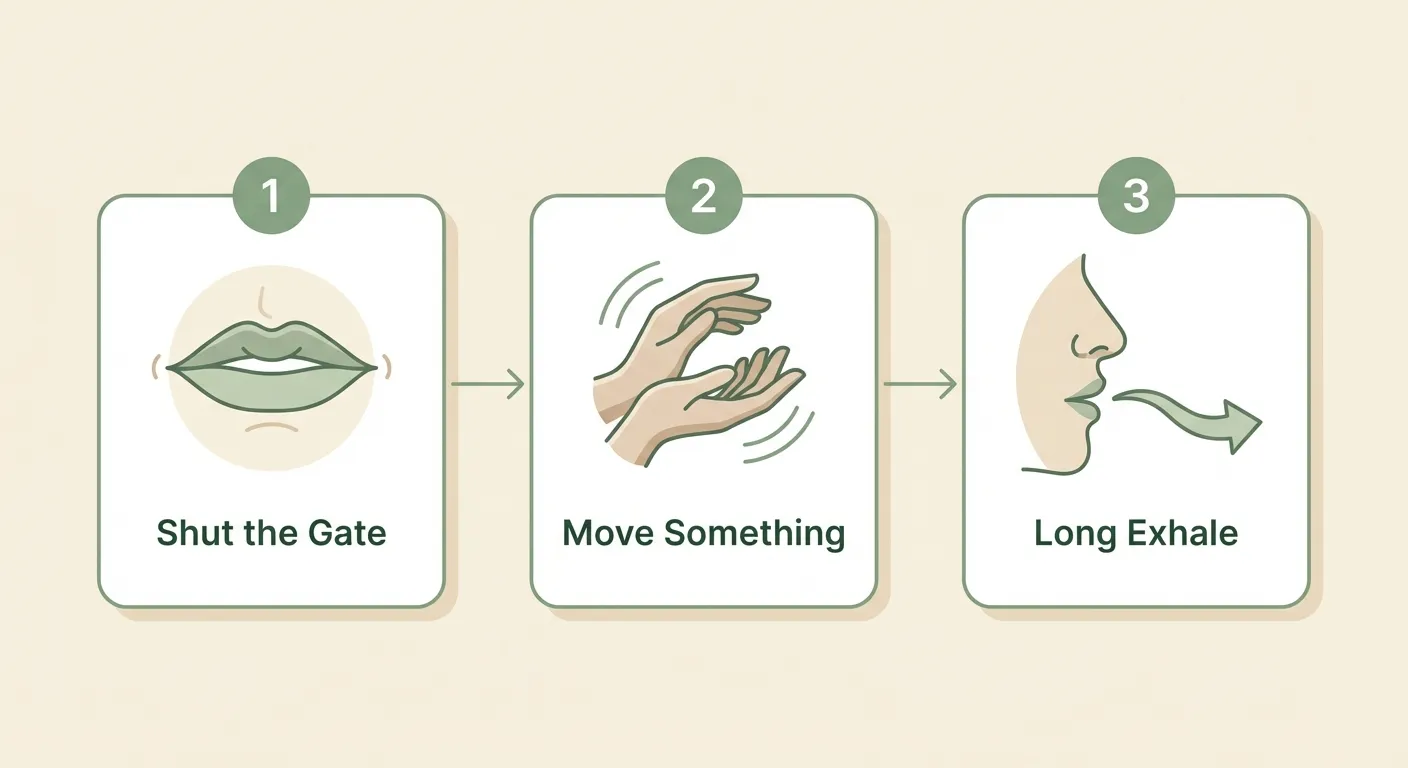
This is not about counting slowly and hoping for the best. There are three specific moves, each one targeting a different part of the stress response. Do them in order.
1
Shut the gate
Close your mouth. Physically press your lips together. If sound is already coming out, switch to a hum or a sigh. The goal is simple: stop the words. You cannot yell through closed lips.
2
Move something
Turn away, step back, press your palms together, shake out your hands. Any physical shift breaks the freeze response and gives your thinking brain time to come back online. Adrenaline wants you to stay locked on the threat. Movement breaks that lock.
3
Long exhale
Breathe out slowly -- longer than your inhale. This activates your parasympathetic nervous system, which is the fastest manual override for adrenaline your body has. One long breath out and your heart rate starts dropping.
Say this (to your kid or yourself)
"Hold on -- I need a second. I want to handle this well."
That single sentence buys you everything. It tells your kid you are not ignoring them. It tells your brain you are choosing, not reacting. And it models exactly the kind of emotional regulation you want them to learn.
Before and After: Same Situation, Different 10 Seconds
| Without the pause |
With the 10 seconds |
| "HOW MANY TIMES DO I HAVE TO TELL YOU?!" |
"I need a second." (pause) "Shoes go by the door. Let's do it now." |
| Kid's brain goes into survival mode. Cannot process instructions. Cries or shuts down. |
Kid hears a firm, clear instruction. Brain stays online. Cooperates (or at least negotiates). |
| You feel guilty for an hour. Apologize later. Same thing happens tomorrow. |
You feel a quiet surge of pride. The skill gets a little stronger each time. |
You do not need to never feel angry. You need to feel angry and choose what comes next. That is the whole skill.
Before the 10 Seconds: Set Your Anchor
The 10-Second Rule works in the moment. But the moment is easier if you have done some prep work. Think of this as pre-loading the skill so it fires when you need it.
A
Write a one-line promise
Something like "I speak firmly and quietly" or "My calm is my power." Put it where you will see it daily -- bathroom mirror, phone lock screen, fridge. This gives your brain a pre-loaded alternative to the yell.
B
Visualize it working (30 seconds, each morning)
Picture a real scenario -- your kid refusing shoes, your toddler throwing food -- and see yourself using the 10-Second Rule. See your mouth close, your hands move, the long breath out. This is not motivation fluff. Visualization physically primes neural pathways. Athletes do it because it works.
C
Make it visible to your family
Tell your kids you are working on using a quieter voice. Put a simple tracker on the fridge -- a calendar where you mark each day you kept your voice down. Accountability from the people you are doing it for is powerful.
After the 10 Seconds: The Warm Return
You have paused. The wave has passed. Now what?
You will know you are ready when your child stops looking like an opponent and starts looking like a kid who needs help. That shift in perception is everything.
1
Reconnect first
Eye contact. Get on their level if they are small. A hand on the shoulder, a quick squeeze. This tells their nervous system "we are okay" before you say a single word.
2
Firm and quiet
You do not have to be sweet. Firm and quiet is more powerful than loud. Say what needs to happen, clearly and once.
Say this
"Okay. I'm ready now. Here's what we need to do."
Know Your Danger Zones
Most parents do not yell randomly. Yelling clusters around specific conditions. Identify yours and you can head them off before the 10-second window even needs to open.
Tired
Lower your expectations for the next hour. Let something slide that normally would not. Protect your reserves.
Hungry
Eat something before addressing the situation. Your blood sugar and your patience are directly linked.
Rushed
Ask yourself: is the deadline real or manufactured? Most "hurry" moments are not actually emergencies.
Touched out
Take five minutes alone. Even stepping into the bathroom counts. Sensory overload is a real trigger, not a weakness.
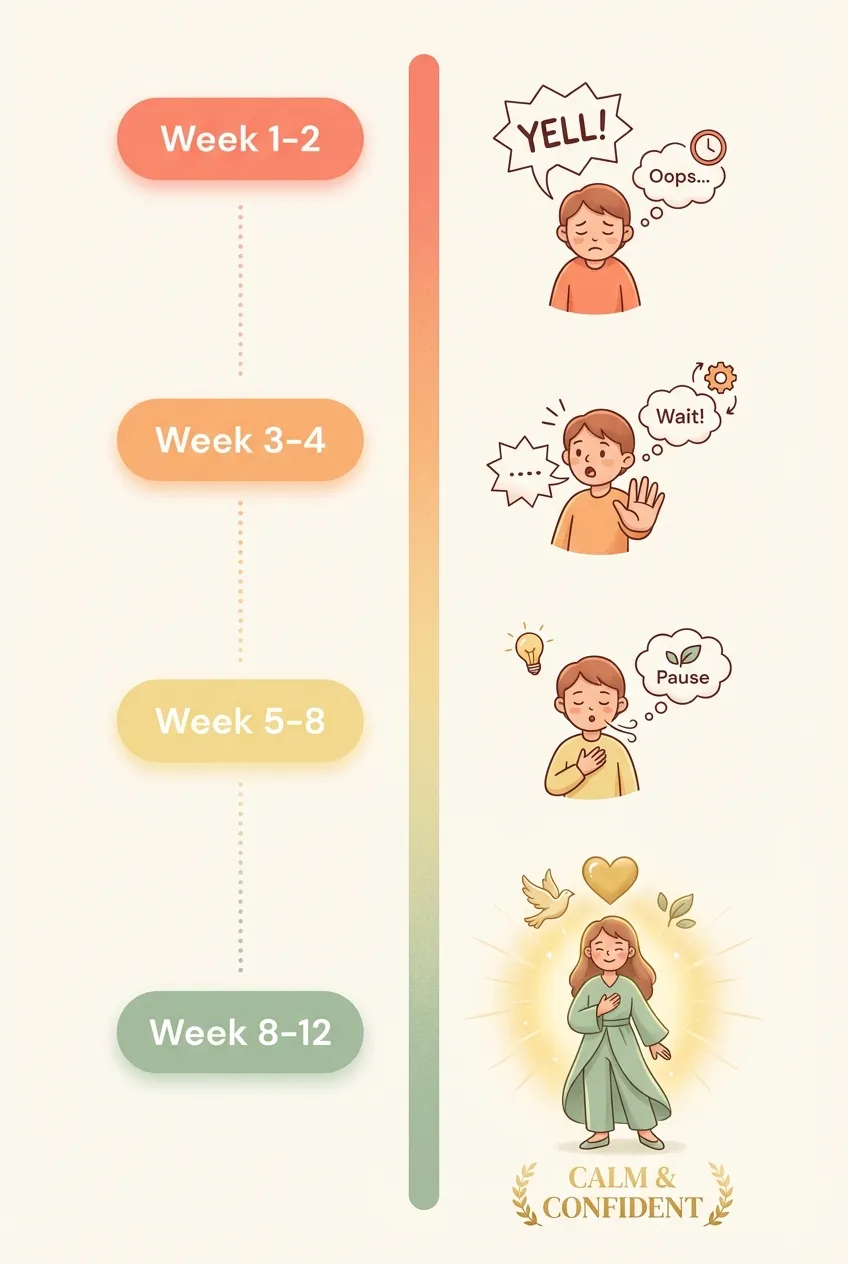
What the Progression Looks Like
Week 1-2
You catch yourself after yelling. You remember the rule too late. You repair afterward. This is normal and it counts.
Week 3-4
You catch yourself mid-yell. You stop partway through. The sentence that started loud ends quiet. Messy, but the skill is forming.
Week 5-8
You feel the surge and pause before it comes out. The 10 seconds start happening automatically. You start noticing the trigger before it triggers.
Week 8-12
Calm is the new default. You still feel the anger -- you always will -- but the pause is habit now. Your kid starts trusting the new pattern.
Honest Questions
"Won't they walk all over me if I stop yelling?"
Quiet is not passive. You still set limits, hold boundaries, follow through. The difference is you do it from authority, not panic. Kids actually take a calm, steady voice more seriously than a loud one. Loud signals that you have lost control. Quiet signals that you have not.
"This feels fake. Should I not just be honest about my feelings?"
You can be honest without being harmful. "I'm really frustrated right now" is honest. Screaming it is not more honest -- it is just less regulated. Your child sees you struggling and managing it. That is one of the most valuable things you can model.
"What if I slip up?"
You will. Probably a lot at first. When it happens: take a breath, go back, and say "I just yelled, and I wish I hadn't. I'm sorry. Let me try that again." Every repair teaches your child that mistakes do not break relationships. The repair IS the skill.
10 seconds. Three moves. A completely different house to grow up in.